
FireDeck
FireDeck is the operational control plane for AI agents, providing identity, authentication, execution control, and real-time risk visibility, with native Lens governance awareness.
In the era of autonomous AI agents, organizations face a critical challenge: agents are no longer simple API endpoints. Agents are operational entities with identities, privileges, risk posture, and supervision requirements. FireDeck addresses this by providing the infrastructure layer that treats AI agents as first-class operational citizens.
Part of the Veilfire Platform — included in every paid tier.

FireDeck transforms AI agents from anonymous services into managed operational entities.
Operate your whole agent fleet
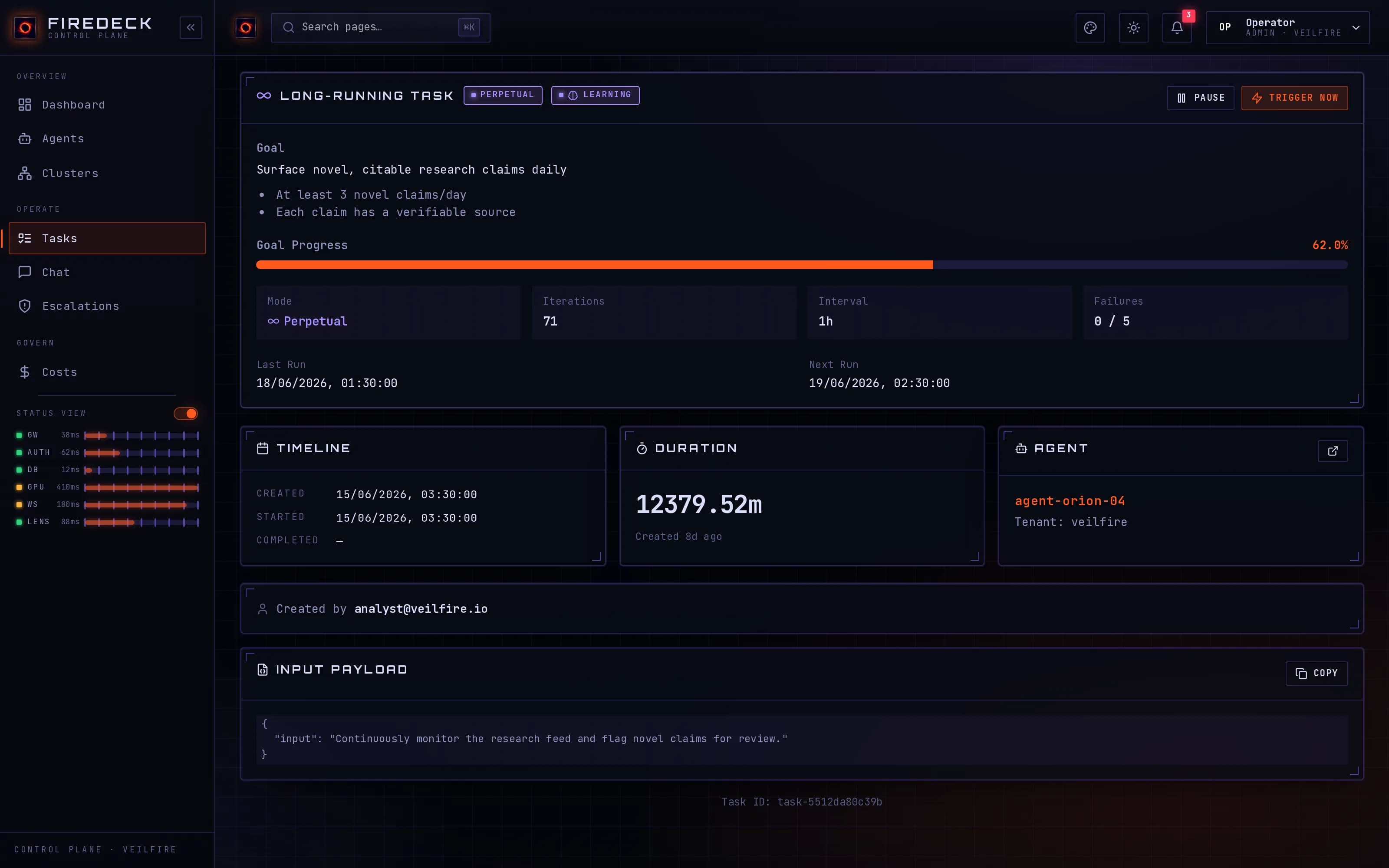
Schedule long-running, autonomous work
Give an agent a goal and let it run — windowed or perpetual — with check intervals, success criteria, iteration limits, and pause, resume, or trigger-now control.
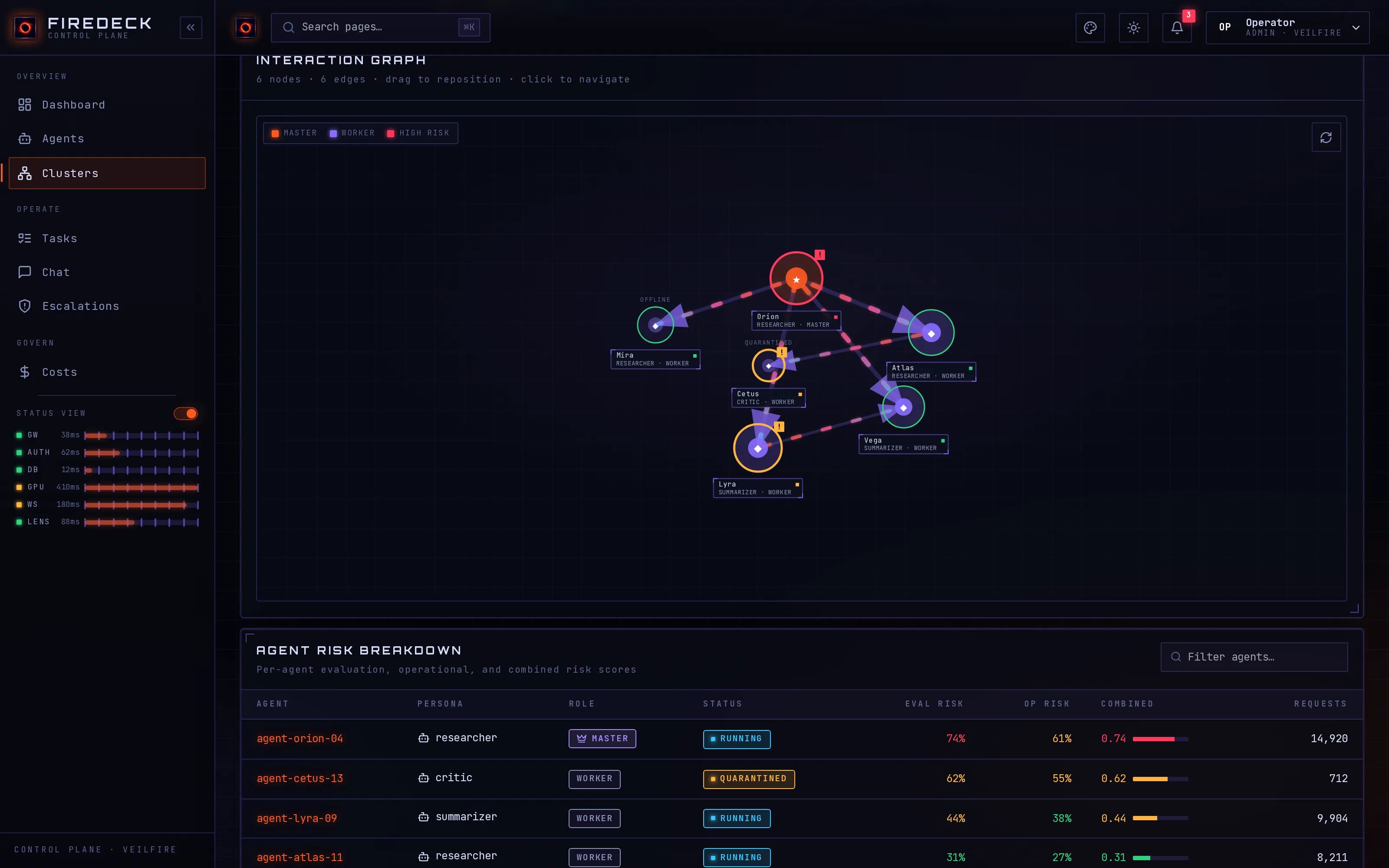
See how your agents collaborate
Visualize multi-agent clusters as a live interaction graph — who hands off to whom, where risk concentrates, and which agent is the hub of a swarm.
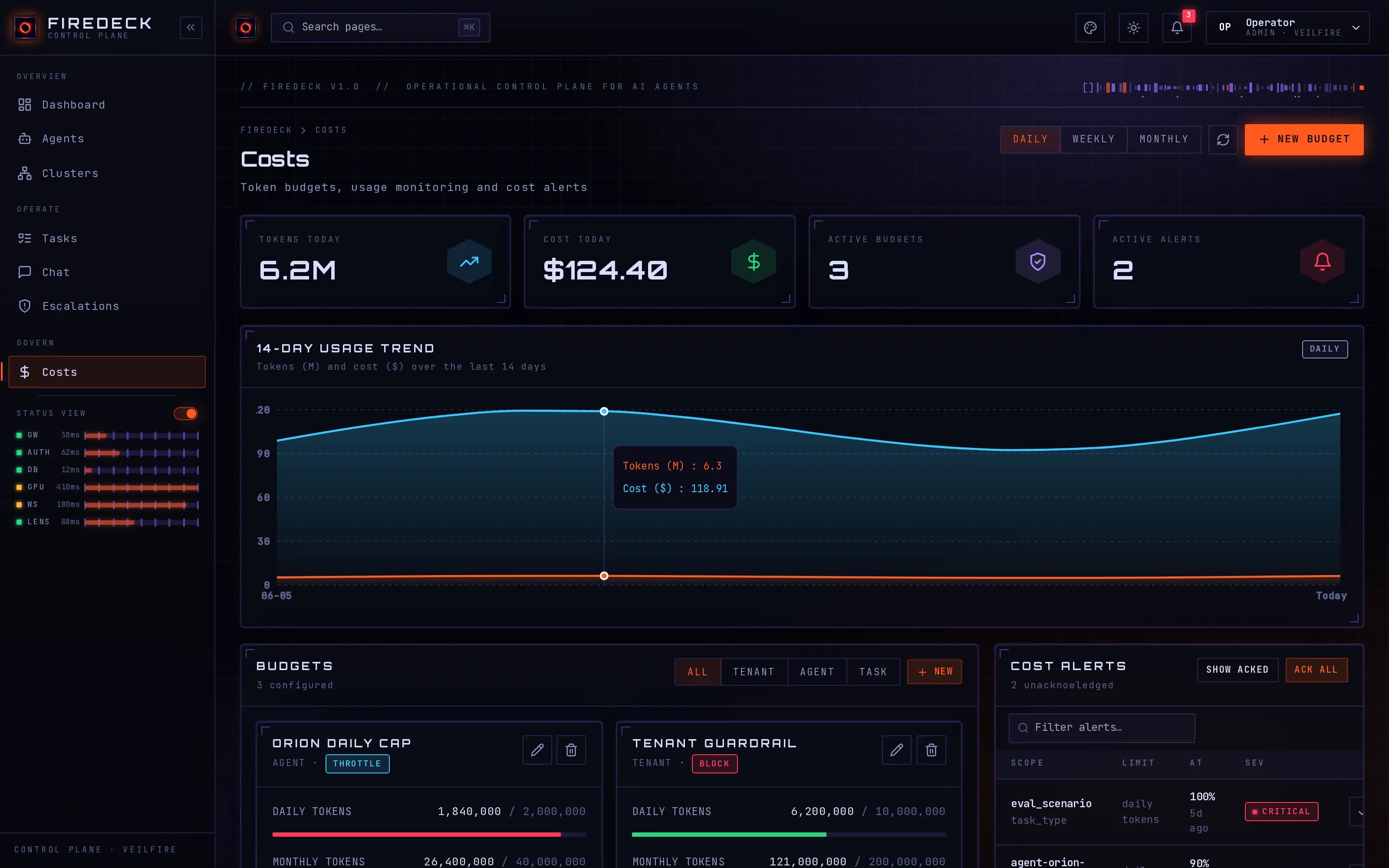
Budgets and alerts for every agent
Set token and dollar budgets per agent, tenant, or task type with warn, throttle, or block enforcement, track usage by model and agent, and get alerted before a fleet overspends.
AI Agents Are Not Just Code
They're Operational Entities
Traditional software monitoring tools were designed for stateless services. AI agents are fundamentally different. They have identity, privileges, risk posture, and require supervision.
| Challenge | Consequence |
|---|---|
| No agent identity management | Rogue or impersonated agents accessing sensitive systems |
| No credential lifecycle | Stale keys, no rotation, no revocation capability |
| No execution visibility | Blind spots in what agents are doing and when |
| No governance integration | Agents operating outside policy boundaries |
| No risk aggregation | Inability to assess organizational AI risk posture |
Core Capabilities
FireDeck provides the complete operational layer for AI agent deployment, treating agents as managed entities rather than anonymous services.
Agent Identity & Authentication
OAuth2 client credentials with JWT-based identity tokens carrying tenant isolation, role claims, and version tracking. One-click credential provisioning, automatic token refresh, and role-based access control (Admin, Developer, Operator, Viewer).
Operational Control
Complete execution management across three modes: real-time WebSocket chat with streaming responses, async task queue with atomic claiming and completion tracking, and batch queue processing. Agent heartbeats for liveness monitoring with manual intervention to pause, resume, or terminate.
Governance Awareness
Native Lens integration for policy-aware operations. Instantly identify governed vs. ungoverned agents, see policy bindings per agent, and enable dual registration. Track policy compliance rate, rule trigger frequency, and ethical/regulatory citations applied to agent behavior.
Risk Visibility
Aggregated risk from multiple sources: eval risk (static baseline from Insight, tracked by agent version), operational risk (runtime accumulation from policy violations), and combined risk posture with color-coded indicators (Green/Yellow/Red) and historical trending.
Ember Integration
Purpose-built for Ember agents with authenticated registration, tenant-scoped operations, and user context propagation. Every tool invocation logged to the Cryptographic Audit Log (CAL), with configurable rate limiting and session-isolated memory with PII awareness.
FireDeck in the Veilfire Stack
VeilfireAuth-backed authentication, tenant-aware operators, and policy owners issue directives.
Credential issuance, agent registry, chat/task orchestration, and telemetry.
Ember fleets authenticate, register, and heartbeat with FireDeck-issued credentials.
Policy enforcement and audit logging, feeding governance signals back to FireDeck.
Scenario-based evaluation and risk scoring closes the loop.
Integration with the Veilfire Platform
FireDeck is part of the complete Veilfire AI governance stack.
| Component | Purpose | Integration |
|---|---|---|
| VeilfireAuth | Centralized identity | Shared realm, agent credentials |
| Ember | AI agent framework | Native agent runtime, tool execution |
| Lens | AI governance platform | Policy enforcement, audit logging |
| Insight | AI safety evaluation | Eval risk scoring, scenario testing |
Real-World Applications
Enterprise AI Agent Deployment
A financial services firm deploys 50 AI agents for customer service, document processing, and internal automation.
- Centralized credential management for all agents
- Role-based access control
- Real-time visibility into agent fleet health
- Governance compliance tracking via Lens
- Risk scoring to identify problematic agents
Regulated Industry Compliance
A healthcare organization must demonstrate AI governance for regulatory audits.
- Complete audit trail of agent operations
- Policy compliance metrics for each agent
- Version tracking with eval scores
- Human-in-the-loop escalation for sensitive decisions
Multi-Tenant SaaS Platform
A SaaS provider offers AI-powered features to multiple enterprise customers.
- Complete tenant isolation
- Per-tenant credential provisioning
- Customer-specific policy enforcement
- Separate risk dashboards per organization
Why FireDeck?
| Capability | Traditional Monitoring | FireDeck |
|---|---|---|
| Agent Identity | None (anonymous services) | Full verifiable identity |
| Credential Management | Manual, scattered | Centralized, lifecycle-managed |
| Governance Integration | Bolt-on, after-the-fact | Native, real-time via Lens |
| Risk Visibility | Logs and alerts | Aggregated risk scores |
| Multi-Tenancy | Application-level | Infrastructure-level |
| Execution Control | Start/stop only | Task queue, chat, supervision |
What FireDeck Delivers
Every agent has verifiable, auditable identity
Keys provisioned, rotated, revoked. Never stale
Tasks, chat, scheduling, all in one place
See which agents are governed, which are not
Know your AI risk posture at a glance
Purpose-built for the Ember agent framework
Cluster-Level Safety & Governance
Multi-agent clusters governed as a single operational unit with bounded autonomy, runtime governance, budget controls, and drift monitoring.
Master/worker role enforcement. Only masters initiate handoffs; workers execute within defined boundaries. No self-modification of policies.
Real-time max_risk, avg_risk, and min_risk across all agents. Drill into eval, operational, and combined risk per agent.
Force-directed visualization of handoff patterns between agents with chronological timeline and trace IDs.
Set spending limits per agent, team, or tenant with configurable periods. Real-time consumption tracking with daily/weekly/monthly summaries.
Automatic notifications when budgets approach or exceed thresholds. Container CPU, memory, PID, and log rotation limits per agent.
Behavioral baselines with automatic detection of persona drift, goal drift, and performance degradation. Full event timeline with acknowledgment workflow.
Validates and sanitizes memory entries before storage to prevent adversarial contamination of shared knowledge.
Failed jobs quarantined for forensic analysis, not silently dropped. Queue depth limits reject new jobs when capacity is exceeded.
Approve, veto, or escalate any decision with full audit trail. Cluster-level risk visibility with override capability for automated containment.
Part of the Veilfire AI Governance Platform
FireDeck is the operational control plane for AI agents. Together with VeilfireAuth, Ember, Lens, and Insight, it provides complete identity, execution, governance, and evaluation for enterprise AI deployments.
One platform, every stage
FireDeck is one component of the Veilfire Platform.
One unified platform — runtime enforcement, identity, evaluations, HITL, and cryptographic audit evidence included.